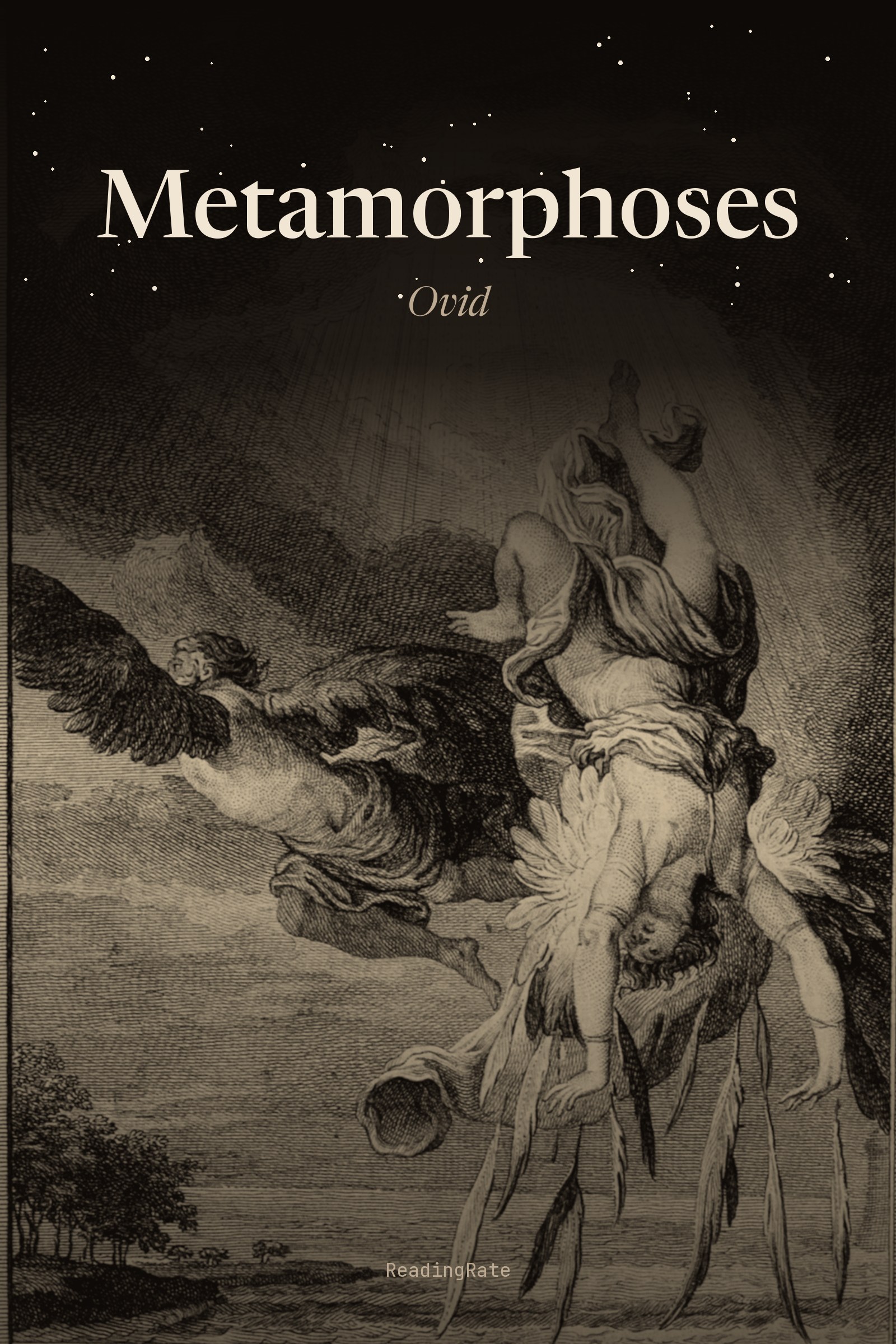
ReadingRate edition
Metamorphoses
Ovid, 8
523 pages · 130,520 words · about 11 hours · regard 91 of 100
Download the EPUB · Read it here · The book's page
Free to read and to download. Asking the Companion about a passage is part of Reader.
Ovid's Metamorphoses, composed around 8 CE, stands as one of the supreme achievements of classical literature—a sprawling epic in fifteen books (this edition presents Books I-VII) that weaves together approximately 250 Greek and Roman myths united by the theme of transformation. Written in elegant Latin hexameters and here rendered into English prose by Henry T. Riley (1851), the work traces a chronological arc from the creation of the cosmos through the deification of Julius Caesar, creating what Ovid called "a perpetual song" of bodies changed into new forms. The narrative moves with extraordinary fluidity between tales of divine passion and punishment, mortal hubris and heroism, featuring such iconic episodes as Apollo's pursuit of Daphne, Phaethon's disastrous ride in the sun-chariot, Perseus's rescue of Andromeda, and Medea's terrible vengeance. Ovid demonstrates remarkable psychological acuity in depicting emotional states—love, jealousy, rage, grief—and their transformative power. His treatment often subverts traditional heroic narratives, giving voice to victims and exploring the darker aspects of divine behavior with irony and pathos. The work serves simultaneously as mythological compendium, artistic showcase, and subtle political commentary. Its influence on Western culture proves immeasurable: it has served as the primary source for classical mythology across centuries, inspiring masterworks of visual art, literature, music, and drama from the medieval period through modernity. This translation includes extensive scholarly apparatus with historical context, geographical notes, and interpretive commentary, making the complex mythological material accessible while preserving the work's literary power and enduring relevance to questions of identity, change, and the human condition.
The text and its markup come from Standard Ebooks, which dedicated them to the public domain. Pages are fixed at 250 words, so a page number is the same on every screen and at every size.
More editions
- Hamlet by William Shakespeare
- Divine Comedy by Dante Alighieri
- Iliad by Homer
- In Search of Lost Time by Marcel Proust
- King Lear by William Shakespeare
- Moby-Dick by Herman Melville
- Paradise Lost by John Milton
- Oedipus Rex by Sophocles
- Adventures of Huckleberry Finn by Mark Twain
- Pride and Prejudice by Jane Austen
- Crime and Punishment by Fyodor Dostoevsky
- Aeneid by Virgil
- Madame Bovary by Gustave Flaubert
- Les Misérables by Victor Hugo
- Great Expectations by Charles Dickens
- The Cherry Orchard by Anton Chekhov
- Frankenstein by Mary Shelley
- Middlemarch by George Eliot
- Tao Te Ching by Laozi
- Leaves of Grass by Walt Whitman
- Dead Souls by Nikolai Gogol
- Heart of Darkness by Joseph Conrad
- Candide by Voltaire
- Mrs. Dalloway by Virginia Woolf
- Jane Eyre by Charlotte Brontë
- Meditations by Marcus Aurelius