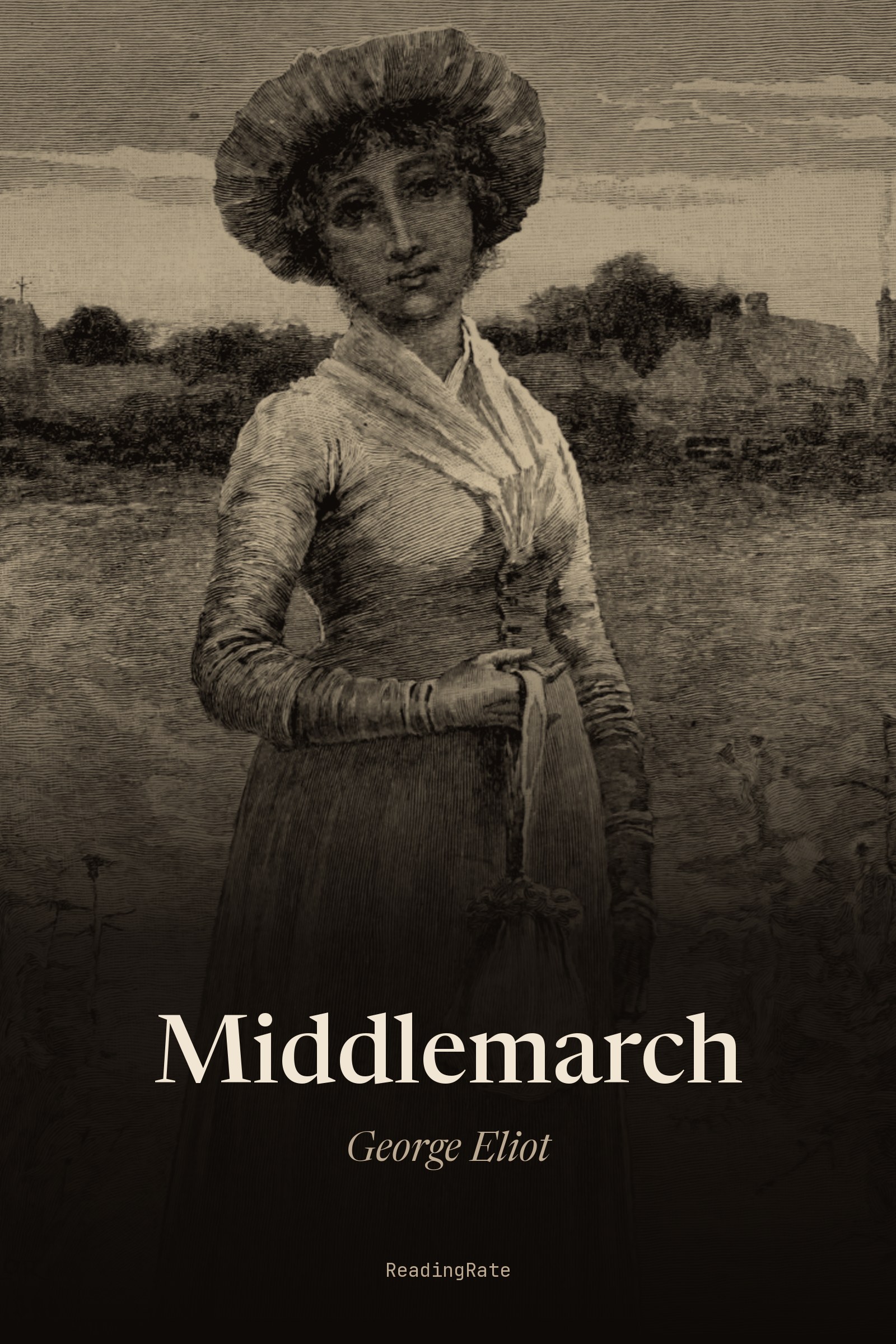
ReadingRate edition
Middlemarch
George Eliot, 1871
1,265 pages · 312,432 words · about 22 hours · regard 91 of 100
Download the EPUB · Read it here · The book's page
Free to read and to download. Asking the Companion about a passage is part of Reader.
Dorothea Brooke is young, idealistic, and determined to marry a man equal to her ambitions. She chooses Edward Casaubon — thirty years her senior, dry, consumed by a scholarly project called the Key to All Mythologies that he will never finish. The marriage fails her in every direction at once. Across the fictional Midlands town of Middlemarch in the 1830s, George Eliot follows a web of lives with substantial plot resolution but enduring ethical tensions: the reforming young doctor Tertius Lydgate, who marries the beautiful Rosamond Vincy and watches his ideals corrode against her social expectations; the morally compromised banker Nicholas Bulstrode, whose buried past resurfaces; the feckless Fred Vincy, whose redemption is aided by Mary Garth's firm love, Caleb Garth's practical training, and Farebrother's intervention. Eliot's narrator stands above the action, ironic and humane at once, tracing the gap between what people believe about themselves and what they actually do. The sentences are long and exacting, coiled with subordinate clauses and moral intelligence. What accumulates is something rare in fiction: a novel that takes ordinary failure — the thwarted life, the compromised marriage, the good intention that slowly bends — and treats it as the substance of history itself. The famous last line argues that the world is better for people who never make it into the history books. After eight hundred pages, that claim lands.
The text and its markup come from Standard Ebooks, which dedicated them to the public domain. Pages are fixed at 250 words, so a page number is the same on every screen and at every size.
More editions
- Hamlet by William Shakespeare
- Divine Comedy by Dante Alighieri
- Iliad by Homer
- In Search of Lost Time by Marcel Proust
- King Lear by William Shakespeare
- Moby-Dick by Herman Melville
- Paradise Lost by John Milton
- Oedipus Rex by Sophocles
- Adventures of Huckleberry Finn by Mark Twain
- Pride and Prejudice by Jane Austen
- Crime and Punishment by Fyodor Dostoevsky
- Aeneid by Virgil
- Madame Bovary by Gustave Flaubert
- Les Misérables by Victor Hugo
- Great Expectations by Charles Dickens
- The Cherry Orchard by Anton Chekhov
- Frankenstein by Mary Shelley
- Tao Te Ching by Laozi
- Leaves of Grass by Walt Whitman
- Dead Souls by Nikolai Gogol
- Metamorphoses by Ovid
- Heart of Darkness by Joseph Conrad
- Candide by Voltaire
- Mrs. Dalloway by Virginia Woolf
- Jane Eyre by Charlotte Brontë
- Meditations by Marcus Aurelius