Tokarczuk’s Flights — fly, you fools
By Simon Stawski · · 7 min read
On Flights by Olga Tokarczuk (2007)
Olga Tokarczuk’s Flights has no plot and does without one: it is a constellation of fragments, travellers and bodies in motion, and its one command is to keep moving. Whoever stops is pinned like an insect; the constellation matters more than the narrative arc.
The book in numbers
- Words
- 117,493
- Difficulty
- 71 out of 100
- Literary regard
- 72 out of 100
- Days to read
- 7
- Rating
- 5 / 5
- Data as of
- 25 October 2026
From ReadingRate.
First published on Substack on 11 October 2025.
I came to this book with resistance. Fitzcarraldo books, I imagined, would be depressing. I read Jon Fosse’s Septology—100 pages of it at least—because I heard great things, because he won a Nobel Prize. I found it too depressing and gave up. I gave Han Kang’s The Vegetarian a read as well, as she’s a Nobel Laureate as well, and was disgusted by the violence and torture of that book. So when ChatGPT recommended Olga Tokarczuk’s Flights, both written by a Nobel laureate and publised by Fitzcarraldo, I braced myself for depression. I was pleasantly surprised.
I’ve been very much into Metamodernism lately, and I don’t find many books that share its values. After all, there’s no clear divide between good and evil, not for death and life either. We don’t live in a movie in which we’re the main character, and other people aren’t NPCs. Flights doesn’t focus on a single story as much as it offers a tender narration of many stories and thoughts, where the collective whole sparkles as a constellation. I still feel a softness for this book weeks after reading it. The pages I have dog-eared and passages underlined still evoke a soft sense of wonder.
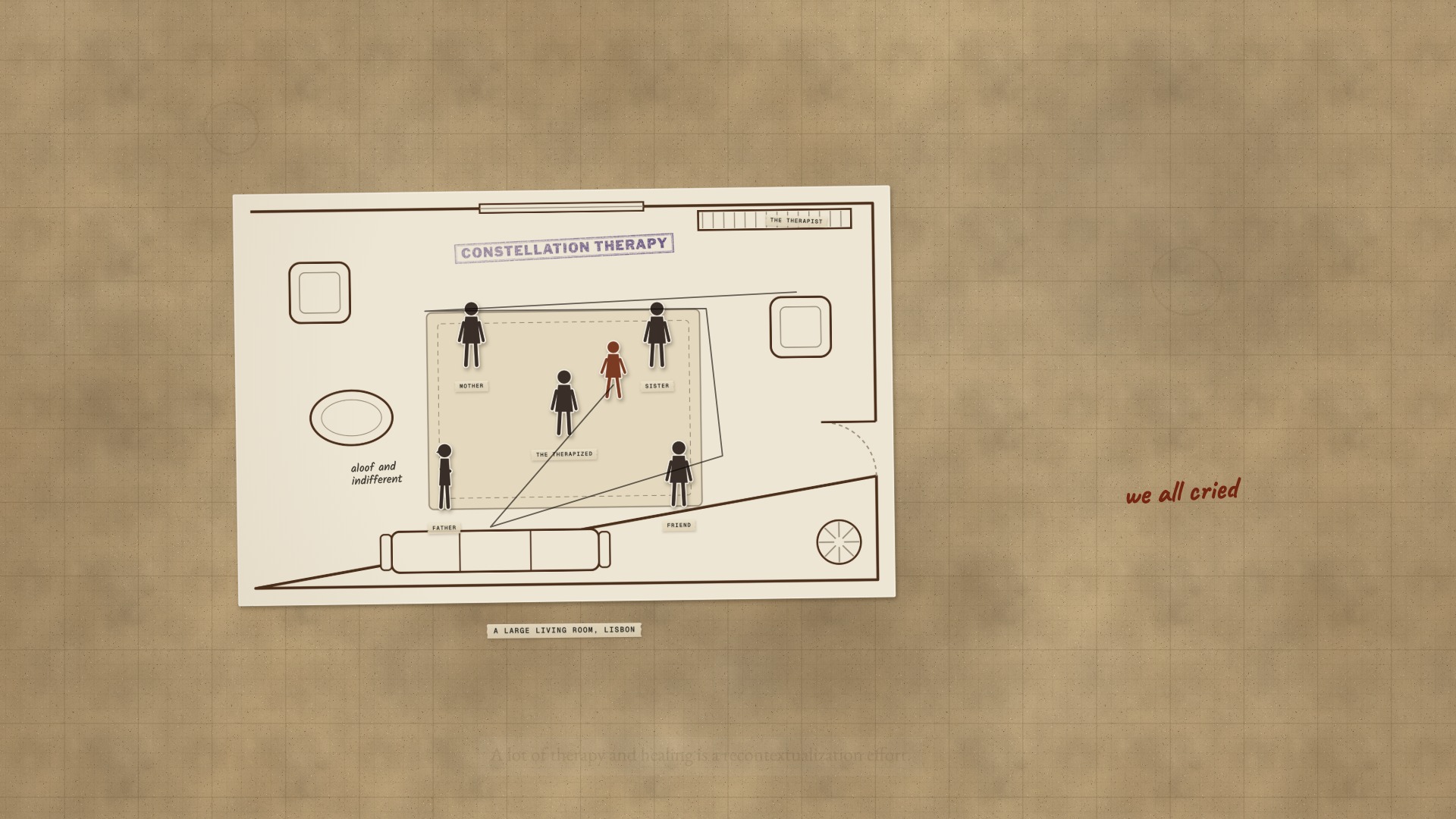
I have a friend in Lisbon who offers Constellation Therapy, and I was a stand-in for a couple of sessions. The person for whom the constellation is focused shares with the group an issue they’re working through. The rest of the attendees are given roles of the people in that scenario. I was once given the father role for someone working through acceptance issues with their parents. I was to pretend to be aloof and indifferent. I would point my body away from the therapized, and look around at everything else except for my dauhter.
In the large living room of one of the members, we were placed in different spots around the room. Father, mother, sister, friend were placed in some proximity to each other and the therapized. We wouldn’t move about the room on our own, but stay in the position we were assigned, with an embodied sense of the character we believed we were playing. I connected the role I was playing with my understanding of my father and his own sense of distance and adamant noninterference. The therapist would walk around the room and engage with each figure, asking them how they’re feeling. The humanizing of each person, the hearing of their embodied sense, gave the whole scenario context and richness that softened the remembered trauma of the therapized. We all cried at their final sense of understanding and imagined reconciliation. I attended two of these sessions, never as the focal point and both times as a paternal figure, and always found them beautiful.
A lot of therapy and healing is a recontextualization effort. The more we can connect with the stories of others, the less harmed we feel. I’ve noticed this in other modalities of therapy I’ve experienced, especially in Mindfulness Based Narrative Inquiry, and even EMDR.
Flights has a sense of constellation therapy to it, a contextualization of many parts, by placing many equally sized, equally valid human experiences in front of you. It’s a collection of sea shells, of fragments, all of which constitute a complete experience. The book doesn’t offer a narrative of linearity, of this happened and then this because of this. There is no plot to this book, just as there is no plot to the nonlinear chaos of our lives. There is only the connecting human experience of movement versus stasis, of understanding the body alive versus the body dead.
The book returns again and again to this central tension. Movement is holy, stasis is death. In my absolute favorite part of the book, a mother of a disabled child and wife of an army vet flees her home for a few days, and connects with a homeless woman. At the end of the story, both are arrested. The homeless woman tells the other to sway.
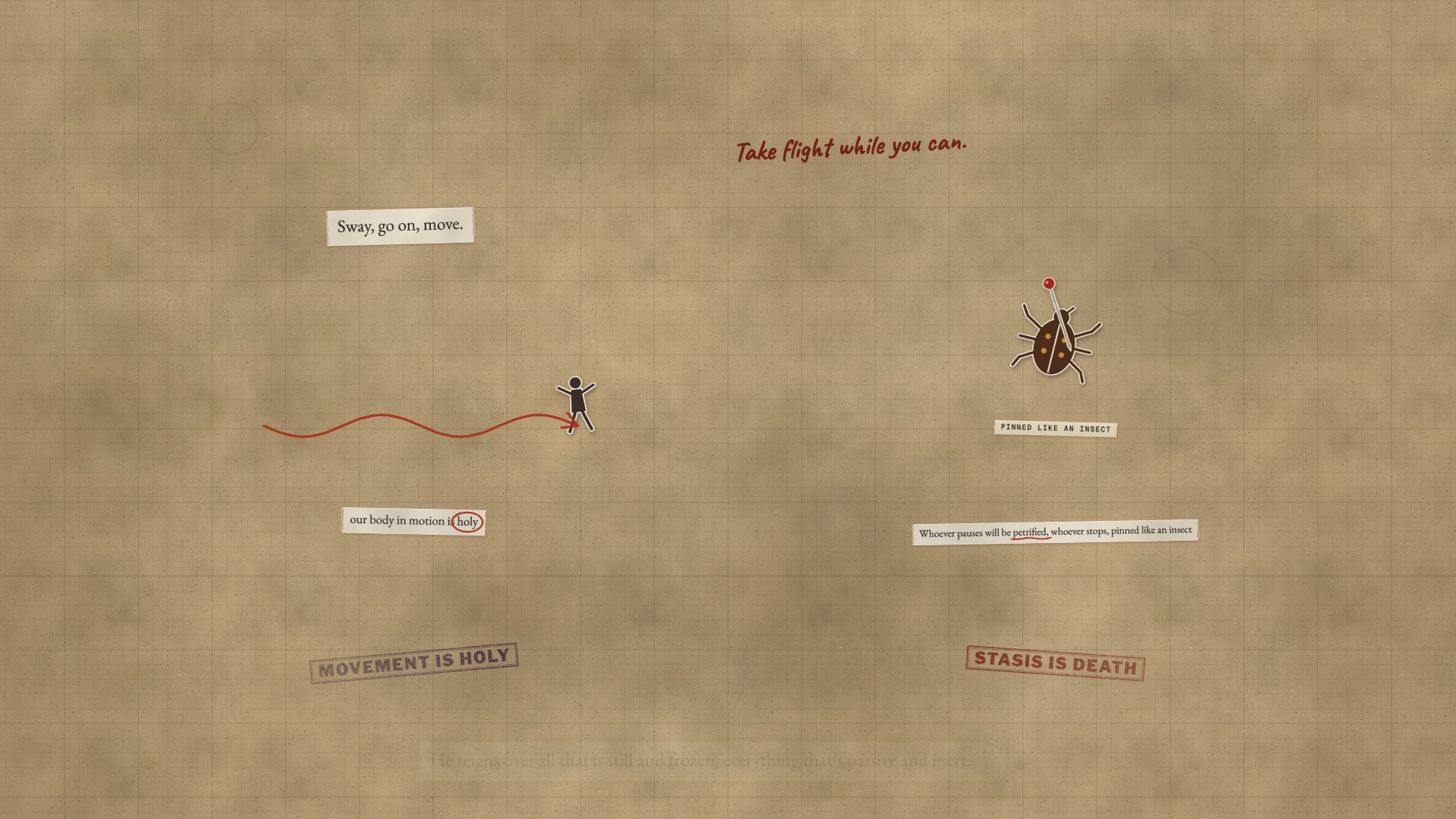
Sway, go on, move. That’s the only way to get away from him. He who rules the world has no power over movement and knows that our body in motion is holy, and only then can you escape him, once you’ve taken off. He reigns over all that is still and frozen, everything that’s passive and inert.
So go, sway, walk, run, take flight, because the second you forget and stand still his massive hands will seize you and turn you into just a puppet, you’ll be enveloped in his breath, stinking of smoke and fumes and the big rubbish dumps outside of town. He will turn your brightly coloured soul into a tiny flat one, cut out of paper, of newspaper, and he will threaten you with fire, disease and war, he will scare you so you lose your peace of mind and cease to sleep. He will mark you and record you in his records, provide you with the documentation of your fall. He’ll occupy your thoughts with unimportant things, what to buy, and what to sell, where things are cheaper and where they’re more expensive. From then on you will worry over trifles—the price of petrol and how that will affect the payments on our loans. You will live every day in pain, as though your life were a sentence. But for what crime? Committed when and by whom? You’ll never know.
For anything that has a stable place in this world—every country, church, every human government, everything that has preserved a form in this hell—is at his command. Everything that is defined, that spans from here to there, that fits into a framework, is written down in registered, numbered, testified to, sworn to; everything collected, displayed, labelled. Everything that holds: houses, chairs, beds, families, earth, sowing, planting, verifying growth. Planning, awaiting the results, outlining schedules, protecting order. Rear your children thus, since you had them without understanding, and set out on the road; bury your parents, who brought you into this world without understanding—and go. Get out of here, go far away, beyond the reach of his breath, beyond his cables and wires and antennas and waves, resist the measurements of his sensitive instruments.
Whoever pauses will be petrified, whoever stops, pinned like an insect, his heart pierced by a wooden needle, his hands and feet drilled through and pinned into the threshold and the ceiling.
My god what a banger of a passage. I’m reminded of Wordsworth’s Intimations, where the “shades of the prison house begin to close about the growing boy.” We’re free when we’re younger, and then life closes around us, traps us. The wife and mother was trapped in the walls of her home, and freed herself momentarily by swaying through the city. Take flight while you can. Read Flights, and the stories of many travelers who have a different sense of life and time and rootlessness. Especially for me, as one who has foregone nationalism for a technofeudalism, as I don’t serve a country as much as a cloud, I heard the command to keep moving from the homeless woman loudly, as I am, in many ways, homeless as well: neither Canadian, nor Polish, as both of my passports suggest, and not Portuguese either.

I have a desire a tender reader to match the tender narrator, who presents all of these fragments as a constellation. Look at the group, the whole. See what they have in common, what phrases they similarly use, what themes they all touch upon, and feel a sense for the whole. There’s not one character. There’s not one identity. You are a multiplicity of identities and moods and hormones and bacteria and ever changing memories and patterns. The whole of you can’t be understood by examining just a part of you.
A part of me wishes that something similar could be done for my book reviews: see the themes I’ve spoken about through each: the philosophical parts here, the personal stories there, the little bit of literary theory sprinkled in, and notice me for the whole. If only I could convince you to be patient enough to attend to these words so much.
I started making YouTube videos in 2008 and told a lot of my story for a long time. In 2020, with my divorce, that story ceased to be told. The narrative structure didn’t hold up anymore. The person I presented as on camera didn’t feel like the person I had become. I tried to add more to my story, but my rapidly and ever changing self didn’t keep up. In such a period of rapid growth and change, I was a new person by the time the ink dried on the chapter I was writing.
And so, the chapters grew sparse, the time between faded, and the belief of picking up again seemed impossible. I had alienated my viewers and left them with no story, no redemption arc, but an unhappily ever after.
Flights suggests a different way to think about this: the constellation matters more than the narrative arc. Movies traditionally follow is the Campbellian Hero’s Journey, though Postmodern autofiction like Solenoid doesn’t complete the story, and stays in the belly of the whale
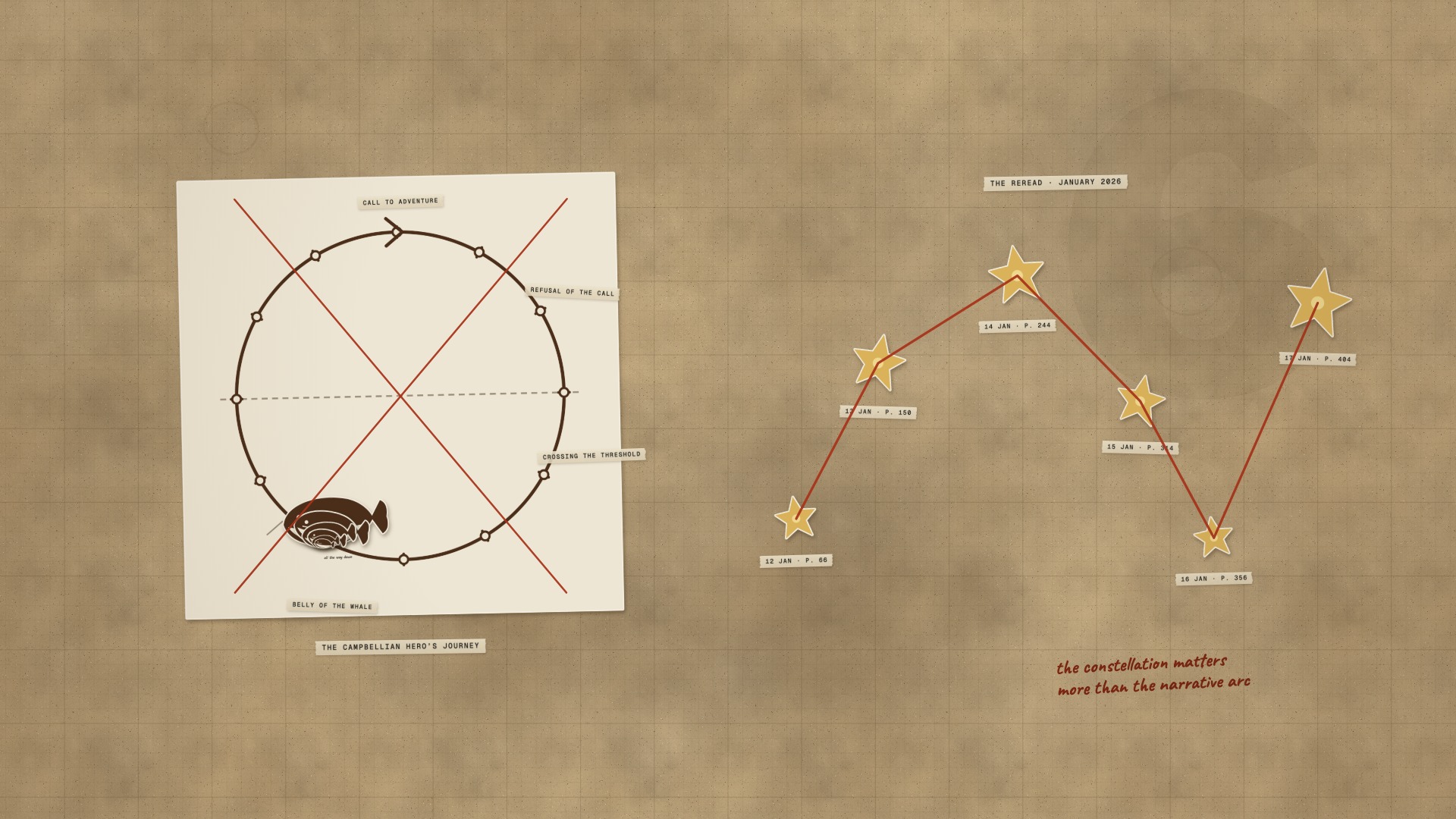
Maybe there is no narrative arc, but just a constellation of different parts of ourselves, different identities, made up of some stars that shine brighter than other. There is no end to the constellation, really. The wider your view of the night sky, the more beautiful the experience.
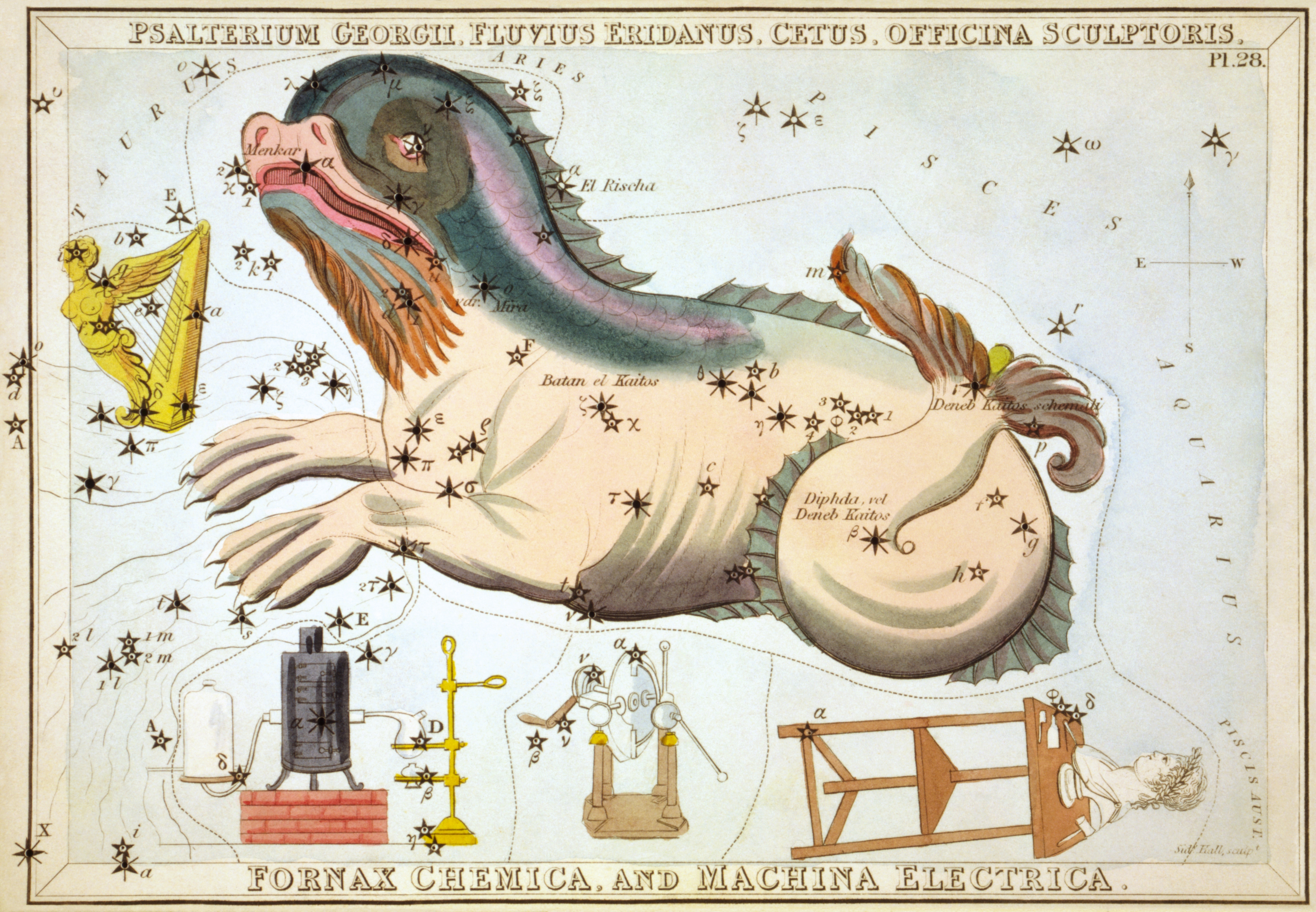

The language is of constellation, not causation. The valuable lesson here is that we don’t see truth on one axis, advancing from left to right, from less truth to more truth, from a before to an after. It’s not post hoc ergo propter hoc, not karma, not determined. Instead, it’s emergent from a cluster of equally sized pieces, all equally held space for, and looking at them from a space that holds all, where time is not the core tenet of truth. Truth is not bound by time, by who was aggrieved first and thus more just in their outrage and demands for justice, leading to eyeless blindness. It’s a game theory refusing to trade tit for tat, pausing in timeless presence with all for what’s emerging here and now.
What if narrative doesn’t have to exist in temporality? Once time is introduced in a telling, we default to story arcs and Campbell. We get linearity instead of circularity, and the light cones of time. Constellation narration doesn’t focus on the resolution of an event but the heightened resolution of a scene. We’re getting more megapixels. One star is nice. Two nicer. A constellation is pretty. A galaxy is gorgeous. The night sky in a darkzone is awe inspiring. The more we share a constellation the more beautiful a picture we get. Constellations escape temporality and enter permanence, presence, the now.
Read the newsletter edition on Substack · Subscribe
Credits
- “First flight of the Wright Flyer, Kill Devil Hills, 17 December 1903”, by John T. Daniels, Library of Congress · Public domain · Source
- “Cetus, with Psalterium Georgii, Fluvius Eridanus, Officina Sculptoris, Fornax Chemica and Machina Electrica, from Urania’s Mirror”, by Sidney Hall, 1825; restoration by Adam Cuerden · Public domain · Source