Mann’s The Magic Mountain — the dangers of healing
By Simon Stawski · · 10 min read
On The Magic Mountain by Thomas Mann (1924)
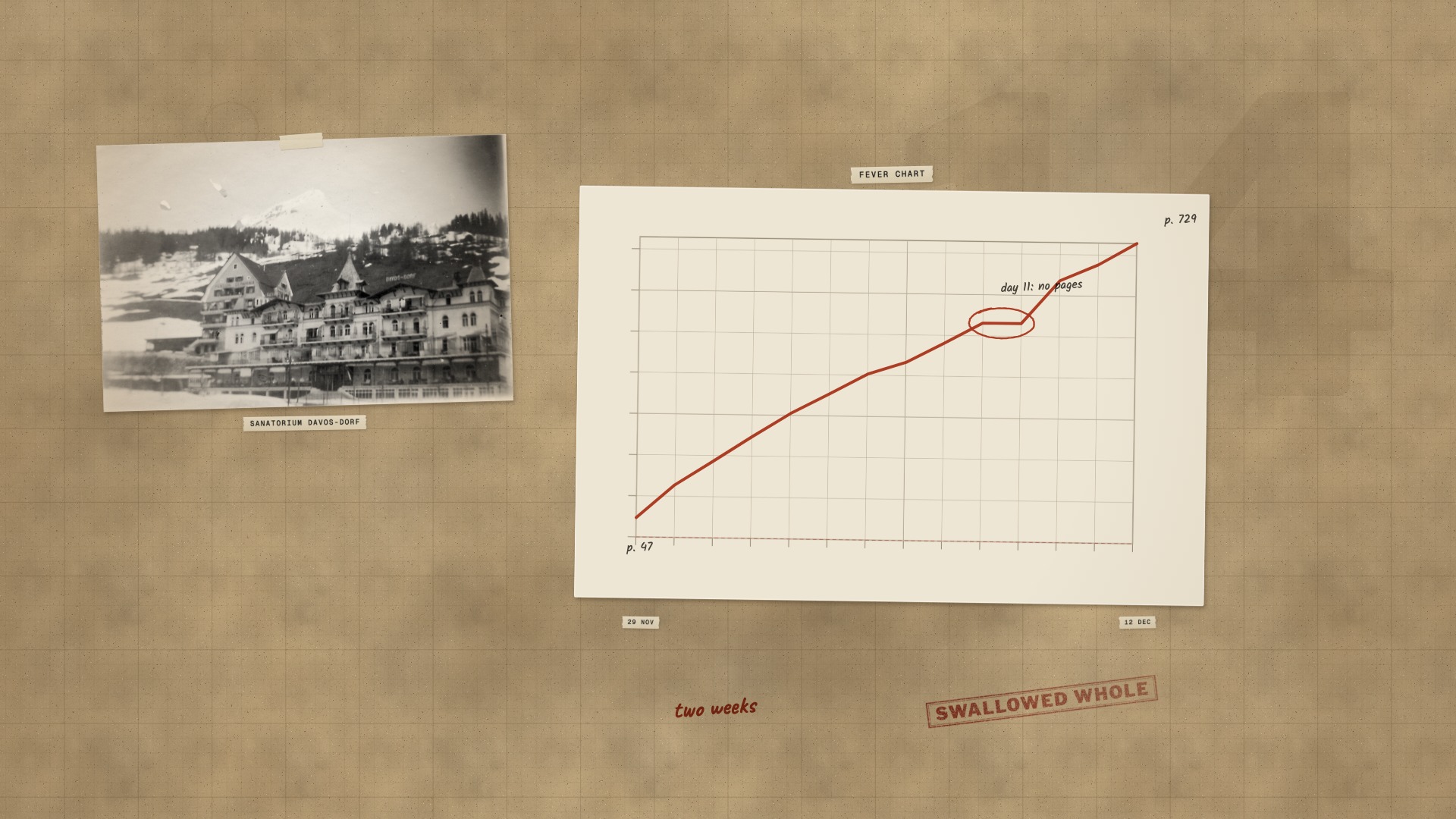
Thomas Mann’s The Magic Mountain is a novel about a cure that never ends: Hans Castorp goes up for three weeks and stays seven years. Settembrini and Naphta argue without a winner, and the only move left is the descent, back down to the village, the bone broth and the book club.
The book in numbers
- Words
- 344,120
- Difficulty
- 62.82 out of 100
- Literary regard
- 87 out of 100
- Days to read
- 14
- Rating
- 5 / 5
- Data as of
- 25 October 2026
From ReadingRate.
First published on Substack on 18 December 2025.
Two weeks ago my partner and I walked home after date night at a tiny candlelit restaurant near Praça das Flores. We drifted along the edge of Príncipe Real, up toward Rato, and found a bookshop that should have been closed by now bubbling with people. We shouldered through the crowd, curious, and only found people lined up to buy books now that the speaking event was over, from what we could see on one of the posters behind the counter.
We don’t read Portuguese books, and so we went to the small English section, five rows deep, where I found The Magic Mountain. I saw it mentioned on the back of Olga Tokarczuk’s The Empusium, and decided Mann would prepare me for reading this book.
My current aim in this stage of my reading plan is to go deep with Tokarczuk. I have all of her books. After I read Flights and Drive Your Plow Over the Bones of the Dead, I want to inhabit her work and her world and not rush through it. This year I hopped from one Booker Prize novel to another, with no connecting thread between them apart from them being recent and well-marketed. My reading had been curated the way my Instagram feed is curated: tempting video thumbnail leads to algorithmic autopilot, without me choosing any destination or goal with my content, and experiencing mild disgust after too many swipes. This year’s books felt the same, just slower.
So I’ve decided to narrow my focus. Instead of going wide with a range of books, I’ll go deep with a few authors: Tokarczuk first, then Joyce, then Proust, then McCarthy. I even made a website to track my progress. I’ll talk about it another time (but it’s so freaking cool I love it!)
What I intended with the Magic Mountain was to take a small detour before the heading back to the real work with Tokarczuk. Instead, I was swallowed whole. I became Hans Castorp. I all but forgot about my previous plans, cut all ties, and lost myself in the mountain for longer than I care to count.
In the two weeks I read this book (I only knew it was two weeks by looking back at my daily reading tracker), I left the house only for the gym and date nights. I cancelled everything else. I called no one, and didn’t answer when they called. I woke up writing about the mountain, after the evenings I spent reading it.
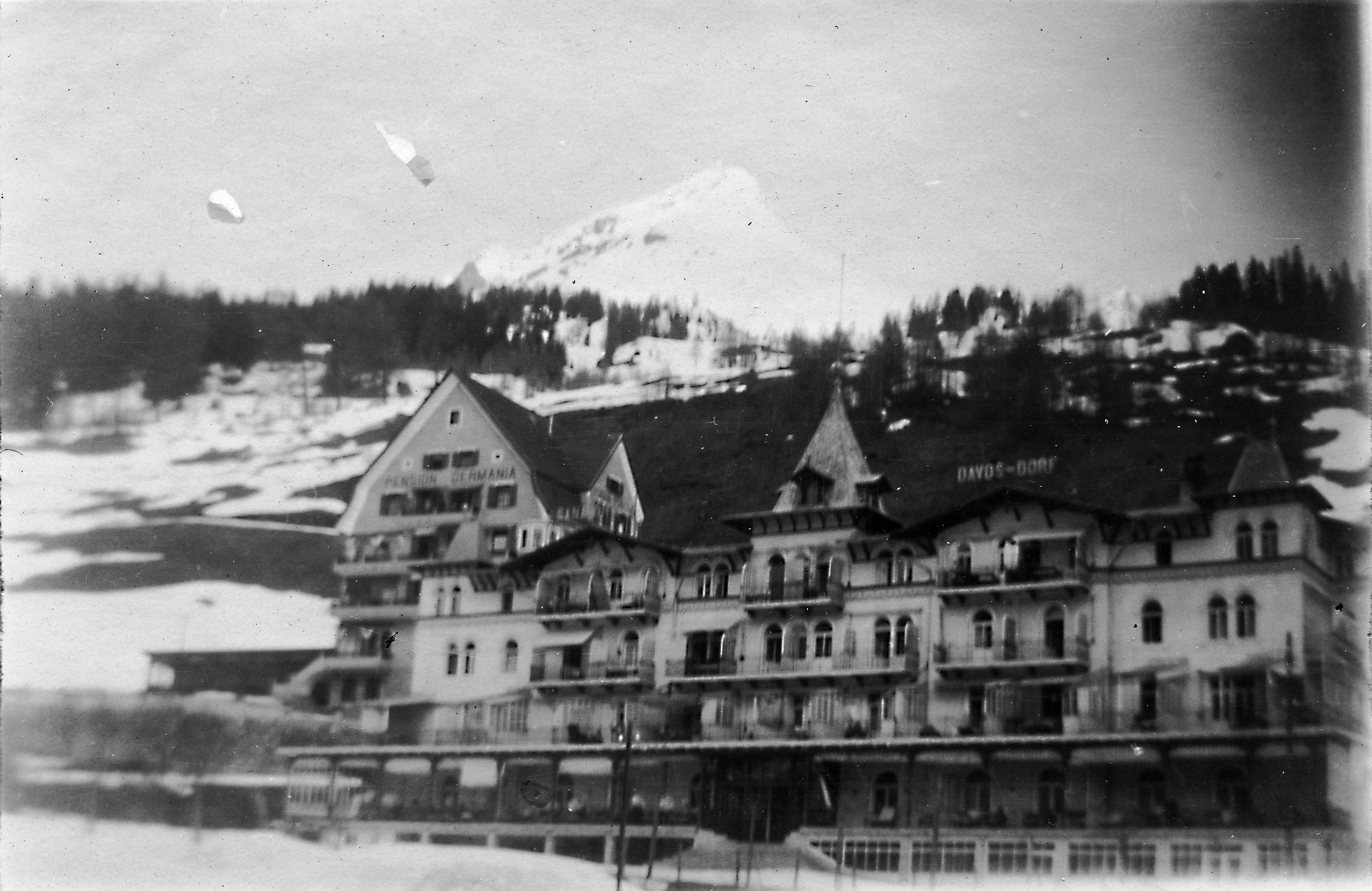
Hans’ story is also one of growth through healing, through antisocial hermeticism, through transubstantiation via disease. I know that journey well. When I got divorced, I went on a three-year sabbatical. No work. No thinking about my life as an influencer. No speaking with my audience. Just hours meditating on esoteric spirituality and nonduality.
I snapped out of it thanks to another man’s story. During the deep meditation phase of my first year in Lisbon I’d walk to Jardim da Graça with my blanket and cushion, set up under a tree, and meditate. Another man was always at the park when I arrived, sitting under another tree, and he was still sitting there when I left an hour later, and would still be there when I returned with my dog hours after that. Eventually I asked about his practice. We talked about awareness and where we direct it, what we notice about it, and touched on nonduality briefly the way you touch a hot pan. He didn’t like discussing it. I was wide-eyed. Why not? It’s the true nature of the world. He agreed, then added that the people he knows who got into it found themselves in a bad place. That was harder still to believe. How? Nondual awareness rids us of our suffering. He agreed again, and added that they couldn’t hold jobs or maintain their careers, and they lost themselves entirely.
I stopped my nondual practice soon after. I know about nonduality still, but I can’t inhabit that space for too long. I’m not financially set for life like Hans. I can’t afford to meditate forever. Hans’ uncle fled the sanatorium for similar reasons:
He had become inwardly aware he would find everything down below wrong and out of place, and that the feeling would last a considerable time before readjustment set in. It would seem to him unnatural to go to his office instead of taking a prescribed walk after breakfast, and thereafter lying richly wrapped horizontal in a balcony.
He feared adopting the vocabulary of healing too thoroughly. Once you understand the language of trauma, the language of suffering, and the need for rest, then returning to the world of busyness becomes intolerable. The more fluent you become in therapyspeak, the more you talk about neurodivergence and integenerational trauma then the more incompatible capitalism and industrialism and work become. Go woke go broke. If you’re driven in one direction, you may find yourself unable to balance with the other. Work too hard and you’ll burn out; but heal too much and you’ll fade out.
The Debate Without End
The sections with Settembrini and Naphta were the most interesting part of the book for me. I was captivated by their debates. I don’t want books to just tell me their plot: I want characters to talk about how they make sense of the world. It’s the same way I prefer to talk with my friends.
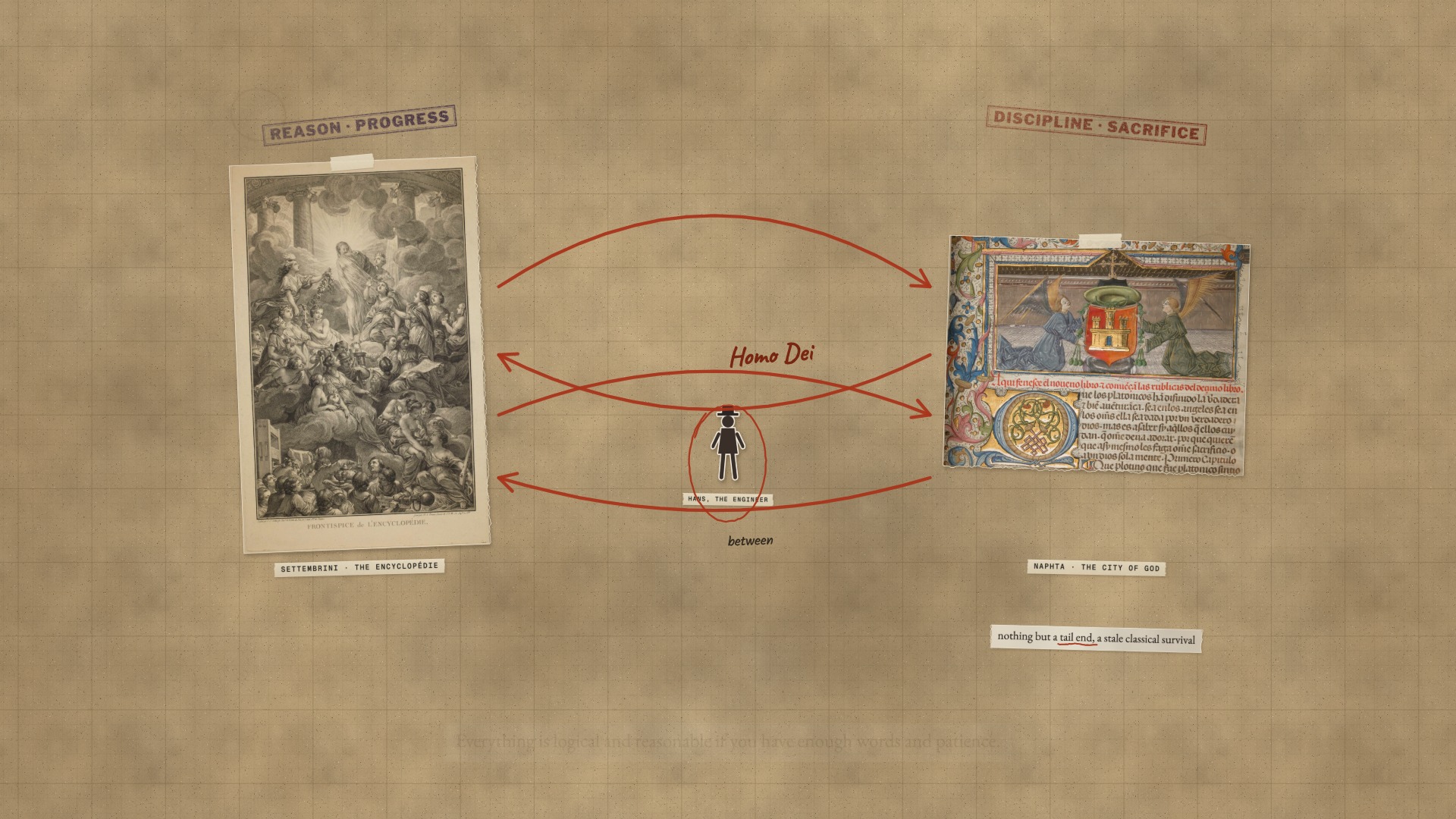
Settembrini and Naphta are dazzling speakers, at complete odds with each other, and tugging you in either direction. Settembrini wants you off the mountain, and speaks for the Enlightenment project, for reason, progress, the individual liberated through education. He believes in arriving at truth through rigor, in building a world where the light of knowledge dispels the darkness of superstition. He constantly refers to Hans as the Engineer, as a constant reminder of who he was supposed to be to the world, as opposed to who he is here up in the mountains. He’s the voice of classical liberalism, of humanism confident in its progress.
Naphta dismantles him, but not through superior logic or better reasoning. His logic is equally matched with Settembrini’s, just aimed in the opposite direction. He speaks against the enlightenment project, speaks for the hermetic tradition, for the Church as civilizational force, for the renunciation of ego in service of something larger:
All educational organizations worthy of the name have always recognized what must be the ultimate and significant principle of pedagogy: namely, the absolute mandate, the iron bond, discipline, sacrifice, the renunciation of the ego, the curbing of the personality.
He directly opposes Settembrini’s egoism and confidence. You must lose yourself and never find it again. And he seems to be anticipating Postmodern studies in academia lately, where we’re made aware of the gross injustices of the Enlightenment project, of all of the brutality that came from colonialism and subjugation of those who weren’t treated as rational actors, of the marginalization of non-white, and of the demonic and nefarious Patriarchy. And so where Settembrini has the grandiose narcissism of the Modernist project, Naphta snuffs it out with the vulnerable narcissism of illness, of scathing irony, of blistering critique, and of endless cynicism. Listen to him tear Settembrini to shreds here:
Your humanity is today nothing but a tail end, a stale classical survival, a spiritual ennui; it is yawning its head off while the new revolution, our revolution, my dear sir, is coming on at a pace. We, when we sow the seeds of doubt deeper than the most up-to-date and modish freethought has ever dreamed of doing, we will know what we are about.
Brutal. Terrifying. The postmodern distrust of grand narratives has sown the seeds of doubt and we’re now reaping the harvest. All aboard losers: we dismantle structures now. We focus on trauma, and disability, and injustice. We distrust builders who aren’t fixers. We eat the rich. Billionaires are evil! We don’t speak the language of growth anymore; only the language of healing.

And yet, trendy as Naphta’s sensibilities are, Mann allows neither Settembrini nor Naphta to defeat the other. Given enough time and patience, they could argue until the heat death of the universe. What Mann does so impressively here is that he gives both characters enough knowledge and rhetorical power so that neither overwhelms the other the way they both initially overwhelm Hans. What’s more is that in their heated debates, both clearly point out contradictions and flaws in the each other’s arguments. No side clearly wins with words alone. Both are equally provable and falsifiable.
Hans was first flustered by them, but after a while he recognizes the rules of the game, and from then on isn’t won over by any one of them, but merely entertained. There is no single path of reason, no ultimate truth achieved through rigour. Everything is logical and reasonable if you have enough words and patience.
The Metamodern Move
And so, with all of the heat from Settembrini and Naphta, Hans makes his big breakthrough alone in the snow. Lost in a blizzard, near death, and hallucinating, he arrives at something beyond the endless debate, or - more accurately - between it.
And in the center is the position of Homo Dei, between recklessness and reason, as the state is between mystic community and windy individualism.
He chooses neither Settembrini’s optimistic individualism nor Naphta’s dissolution into the collective, but a third position: the middle way. It’s not a synthesis that resolves their contradiction, as much as it’s a way of holding both without being captured by either.
This is what Metamodernism offers: an understanding that there is no correct answer between Modern heroism and Postmodern victimhood, between full agency and complete surrender. It’s to recognize that both positions, pushed to their conclusions, dissolve into language games and gotcha word traps. They’re brilliant, elaborate, and infinite. Both can play forever. And while they play, people around them will still suffer, die, and need company.
Hans responds by turning toward community. He can’t save the world, but he can help those around him in need. He doesn’t serve the nation he doesn’t know, but the village he does. When his peers talk about “real service,” like Joachim’s military duty, or Settembrini’s civilizational project, then Hans visits the dying of the sanatorium. That’s beautiful. He sits with them. He brings them flowers. He’s human to them while the rest of sanatorium ignores them. This is dismissed as not serious, but it’s the only move that doesn’t require winning an argument first, and his actions speak louder than Settembrini’s or Naphta’s words.
The Village in the Anonymous City
What Hans retreats to is something like the village, something like the pre-modern traditional form of community that Modernism dissolved and Postmodernism critiques without either side offering a fulfilling alternative. His decision is small scale, and it’s specific, and based on presence rather than ideology.
I’m trying to build this in Lisbon.
My circle of Lisbon is filled with Refugees of Capitalism. These are people burnt out from careers in companies that wrung them for everything. They come to Portugal to heal through kirtans and cocoa, pilates and psychedelics, sharing circles and yoga. The sanatorium energy is everywhere. We’re all convalescing.

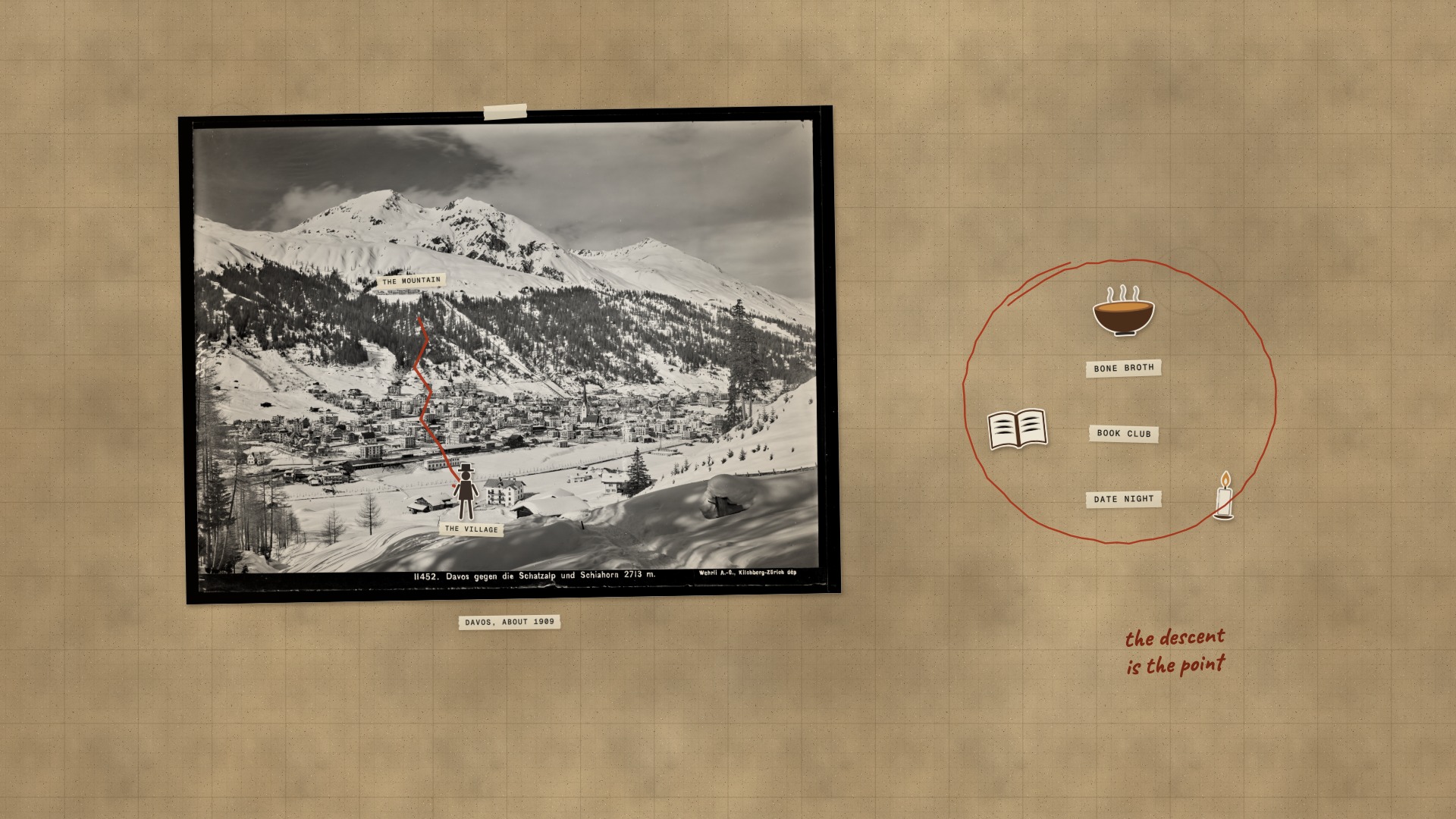
I bring bone broth to my community. I host book clubs. I’m looking for ways to participate more, in this attempt to make a village in an anonymous city, knowing that villages are required but still unfashionable, knowing that the postmodern critique would deconstruct them instantly as exclusionary, privileged, nostalgic, and regressive. There’s tension here I haven’t resolved. How do you honor the need for healing without adopting its vocabulary so thoroughly that you can’t function? How do you build without ignoring what the deconstructors correctly identified? How do you form community without pretending you’ve found the answer the philosophers missed?
I don’t know. But Peeperkorn suggests something:
Put Herr Naphta in one corner of the room, and let him deliver discourse on Gregory the Great and The City of God — it would be highly worth listening to — and put Mynheer Peeperkorn in the other, with his extraordinary mouth and the wrinkles on his forehead, and let him not say a word except ‘By all means — settled, ladies and gentlemen!’ You will see everybody gather around Mynheer Peeperkorn.
Nobody cares about your philosophy if you’re not embodied. Peeperkorn can barely complete a sentence, but he’s so damned charming and lively. He’s charismatic, robust, and present. People want to be near him. The medium is the message.
The village you want to be in starts with showing up, for yourself by living in a body you want to be in, and for others by living as a body that they want to be around. Then the philosophy can happen, or not. But they happen among people who’ve already chosen each other, who are holding space for each other, who genuinely want to meet each other’s needs, rather than trying to win over anonymous trolls and engaging bots online.
Sit and Sweep the Garden
I’m reminded of a phrase by Jack Kornfield, who writes gorgeous books about Buddhism, and it goes: after the enlightenment, the laundry.
There is no final cure. Joachim leaves the sanatorium before he’s healed because he can’t wait forever: “I cannot wait any longer if I don’t want to miss my opportunity. I cannot wait to make my full cure up here.”
Healing can become its own trap. Rest enough so you can rest more. Journal enough to go even deeper. Optimize your sleep, your supplements, and once you have those perfected, find another protocol to incorporate, another toxin to flush, another trauma to process. The sanatorium extends infinitely inward. There is no end to how much you can heal.
I don’t know where the line is. I’m still finding ways to heal, and still growing at the same time. Still reading Mann and Tokarczuk and Joyce when I should be working. Still exercising, still writing, still processing. But I’m also making broth. Hosting clubs. Building community. Showing up for people who didn’t ask for my philosophy.
Hans, in the end, goes to war. The sanatorium dissolves around him and he marches in the mud with a song on his lips. Whether he lives, Mann doesn’t say. It doesn’t matter. What matters is that he left. That after years on the mountain, lost in time, lost in debate, lost in the horizontal life, he descended.
The descent is the point. The village, the bone broth, the book club, the date night at the candlelit restaurant. The service that isn’t “real service” because it doesn’t save the world. Just show up. Just makes something warm for the people in front of you.
Read the newsletter edition on Substack · Subscribe
Credits
- “Sanatorium Davos-Dorf”, by Edith Södergran’s album, Svenska litteratursällskapet i Finland · CC BY 4.0 · Source
- “The Burning of the Houses of Lords and Commons, 16 October 1834”, by J. M. W. Turner, 1835, Cleveland Museum of Art · Public domain · Source
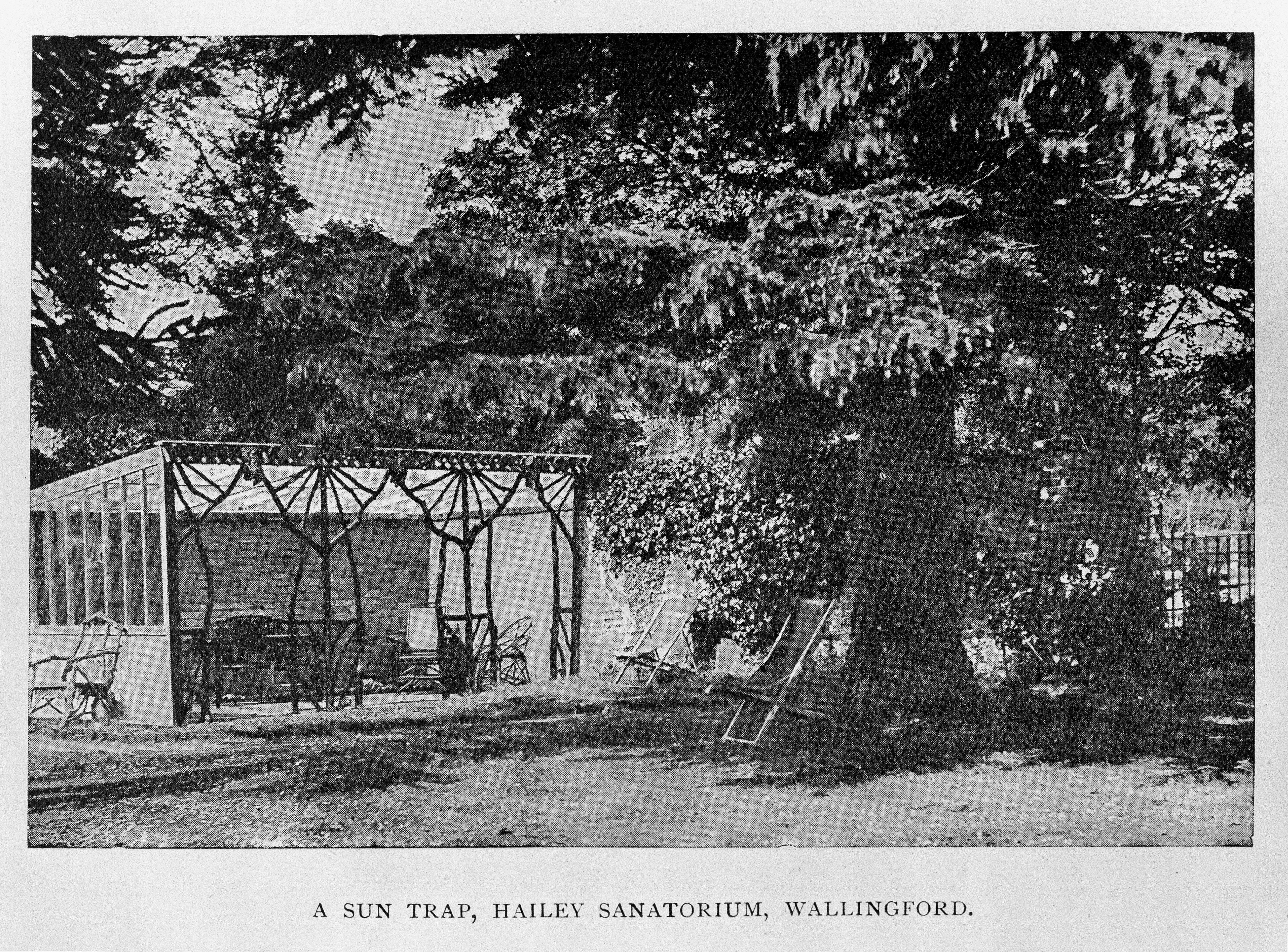
- “A sun trap, Hailey Sanatorium, Wallingford, from A Handbook of the Open Air Treatment”, by Wellcome Collection · CC BY 4.0 · Source
- “Frontispiece of the Encyclopédie”, by Benoît-Louis Prévost after Charles-Nicolas Cochin, 1772 · Public domain · Source
- “Spanish translation of Saint Augustine’s City of God, 15th century”, by Cano de Aranda, The Metropolitan Museum of Art · CC0 1.0 · Source
- “Davos gegen die Schatzalp und Schiahorn”, by Photoglob-Wehrli, about 1909, Swiss National Library · Public domain · Source
