Powers’ The Overstory — welcome to the misanthropocene, now please leave
By Simon Stawski · · 14 min read
On The Overstory by Richard Powers (2018)
Richard Powers’ The Overstory won the Pulitzer for a novel about trees, and Simon finished its 600 pages feeling scolded. He names the mood the Misanthropocene, where environmental love turns into self-hatred, and argues for the opposite move: keep moving, keep building, and find a way off the planet.
The book in numbers
- Words
- 172,960
- Difficulty
- 56.82 out of 100
- Literary regard
- 80 out of 100
- Data as of
- 25 October 2026
From ReadingRate.
First published on Substack on 26 August 2025.
David Attenborough narrates the beautiful and secret rituals of animals, and ends his videos describing how humans are destroying the ecosystem. He’s very effective. His voice is so soothing and wise and oh so British. His format follows how we have been taught to think about nature, as part of our institutionalized Cynical upbringing. Humans are the most dangerous animal, and a blight on the planet. And so, can you, dear reader, resist the same conclusion from a Pulitzer Prize winning novel about trees and not hate humanity by the end of it? I’ll show you how to avoid ecological self-loathing by the end of this review.
I began enduring my self-abuse with this book with a naive hope for something more than a 600 page guilt trip. ChatGPT has recommended The Overstory in all of my asks for Metamodern reading lists, and Metamodernism weighs both sincerity with irony, both hope with despair. While the despair from climate anxiety is well indoctrinated in many of us by now, ChatGPT’s promise of Metamodernism in this book offered me some hope for hope. When I tried to buy it from Amazon it was sold out (I live in Portugal, by the way, so I'm using Amazon Spain), and so I believed it to be a hot item. I bought it secondhand and waited a month for it to arrive, and then I rushed through the other books I was reading so that I could offer it my undivided attention.
I was resistant for the first 150 pages. Every story seemed disconnected apart from the mention of a tree—someone took pictures of a tree, someone else crashed into a tree, another landed in one, while another fell. Neither the stories nor the characters interested me, and I was about to give up on the book until Patricia’s section. That’s when the book began to blossom for me, as I connected with her reverential love and appreciation of the sublime when she's working with the forest.
There Are No Trees in The Forest
Her section brought me back to that love of nature I feel with Wordsworth’s poetry, Kimmerer’s Braiding Sweetgrass, and Stamet’s Fantastic Fungi. After reading The Hidden Life of Trees last year, and learning how they communicate with each other, I was excited with Patricia's discovery of tree communication, and I deeply empathized with her being laughed out of her profession, and I thought "but it's true! It's in another book I read!" This passage here is the first in the book in which I felt my heart race, where I began to appreciate Powers’ powers.
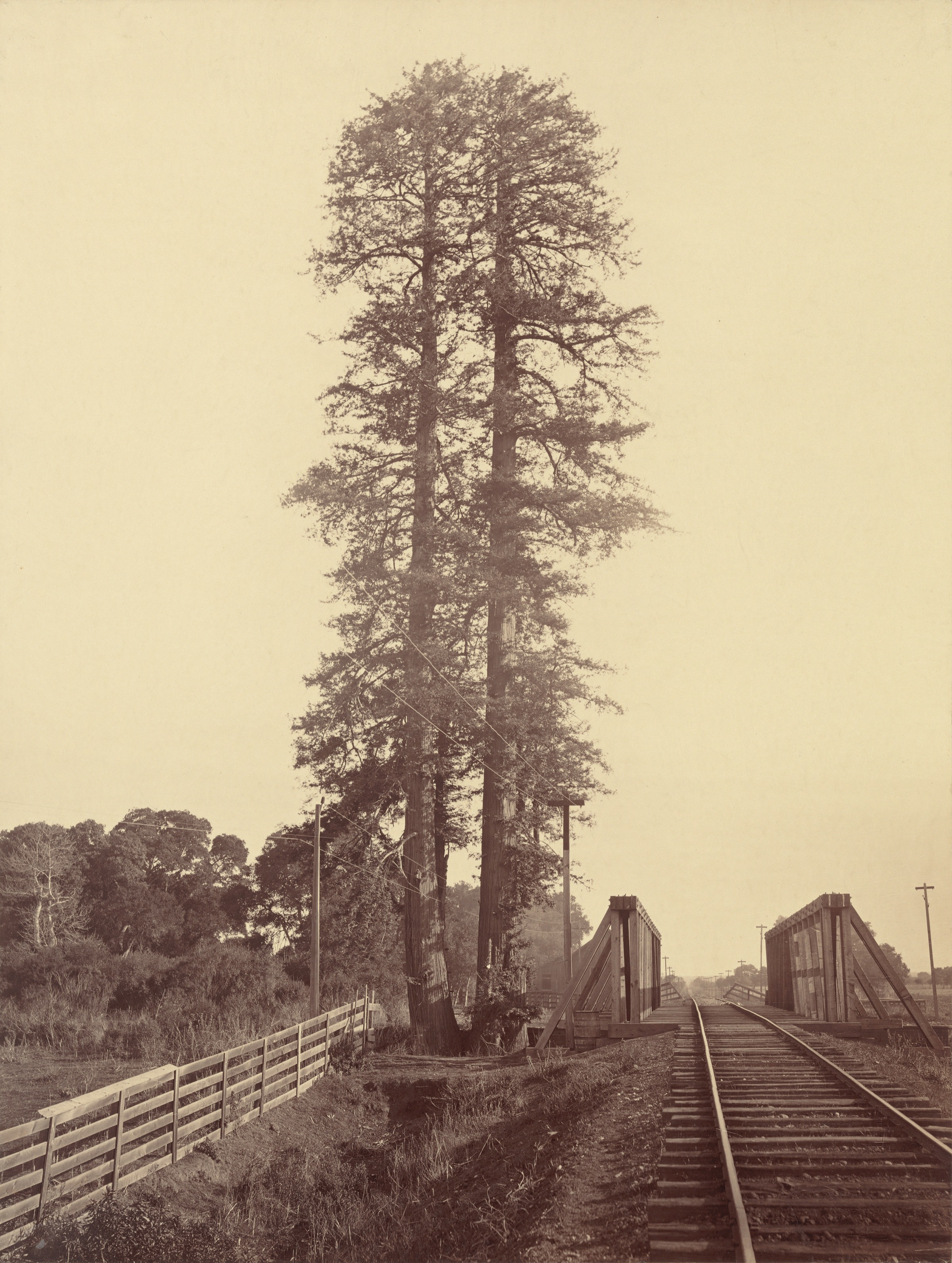

I’ve been a city boy all of my life, growing more aware each year of hyper-individualization. I don’t know the names of my neighbours. I spent a lot of time on the cushion, meditating on nonduality, and knowing that there are no boundaries in this quantum froth we all are, but that’s hard to feel on a social level. And so, that first line here opened me up. Individuation isn’t the only illusion; so is competition. And with so much anti-capitalist, anti-hierarchy language in cultural discourse lately, it’s hard not to read this passage and feel welcomed in by Patricia. You are not alone, dear reader. You are the forest.
I remember sitting in a hammock in Marbella last summer, looking out at La Concha, a mountain covered in trees, and thinking about how all the trees are connected at the bottom through roots and mycelium. It reminded me of how our brain hemispheres connect through neurons communicating with one another. I started sharing this question with my friends: are all trees one tree? When I looked at that mountain from a distance, instead of seeing individual trees, I saw one gigantic biomass—the colossal whale of a mountain, trees sprouting like hairs from a scalp, all connected as one. And so when I read this passage, and then took a picture of it and read it to my partner and shared it across my socials, I was convinced that I was going to love the rest of what the book had in store for me.
Well I sure was wrong. At this point I was open to receiving more language for me to feel more connected with the world, with other species, and with others. By the end of the book, I felt isolated from nature and unsympathetic to environmentalists.
The Aphantasia of Environmental Virtue
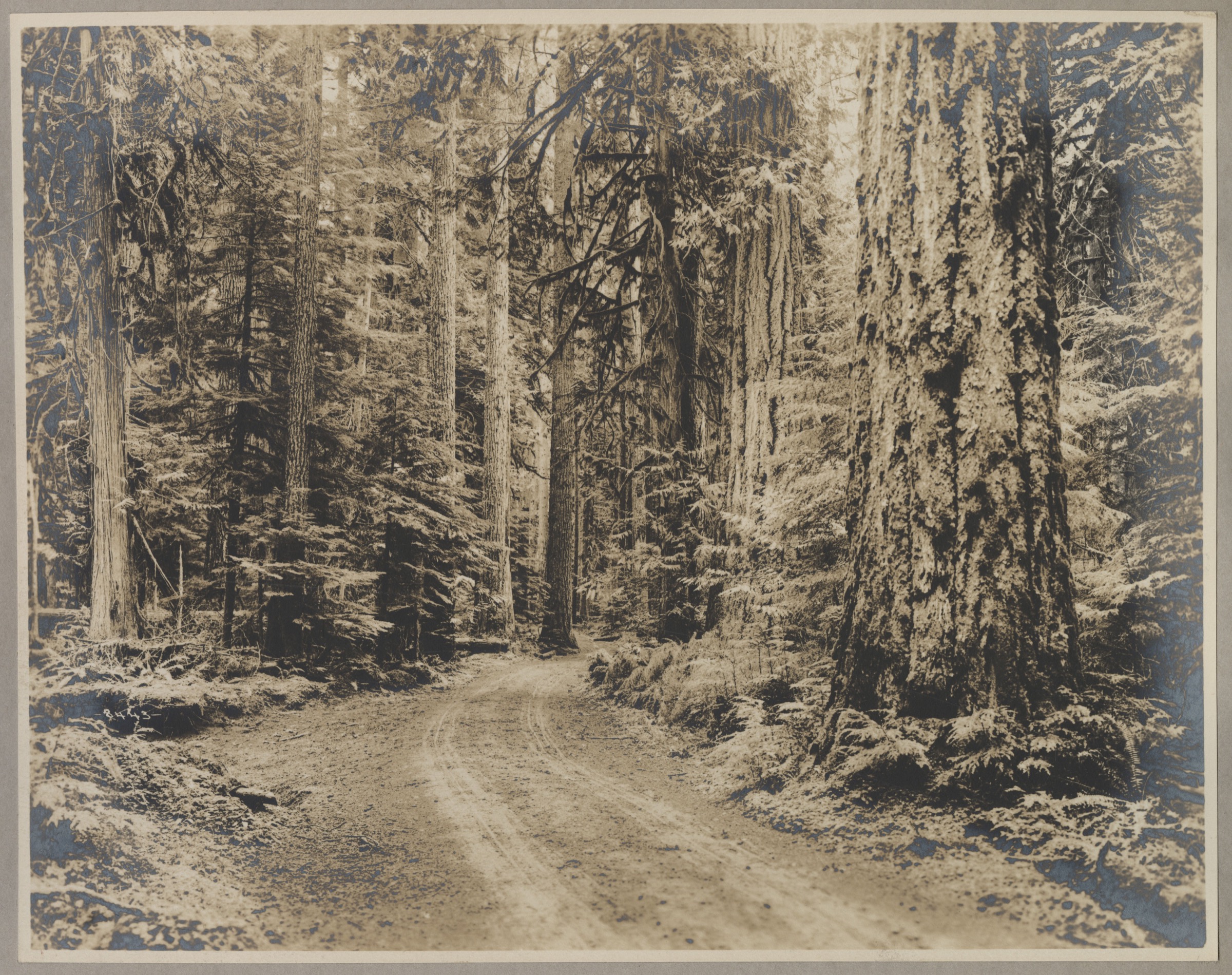
I had such a strange experience in Patricia's chapters. There are a few scenes when Patricia walks through the forest, naming trees I don't know. In those moments, my mind was blank. I saw nothing but words on a page. My vision could not transport to where she was. I had to reread her chapters and replace the specific names of trees with just the word "tree" to be able to create some mental image of what's happening. In her walk through the forest, I was invited by the author, but I wasn't able to join her.
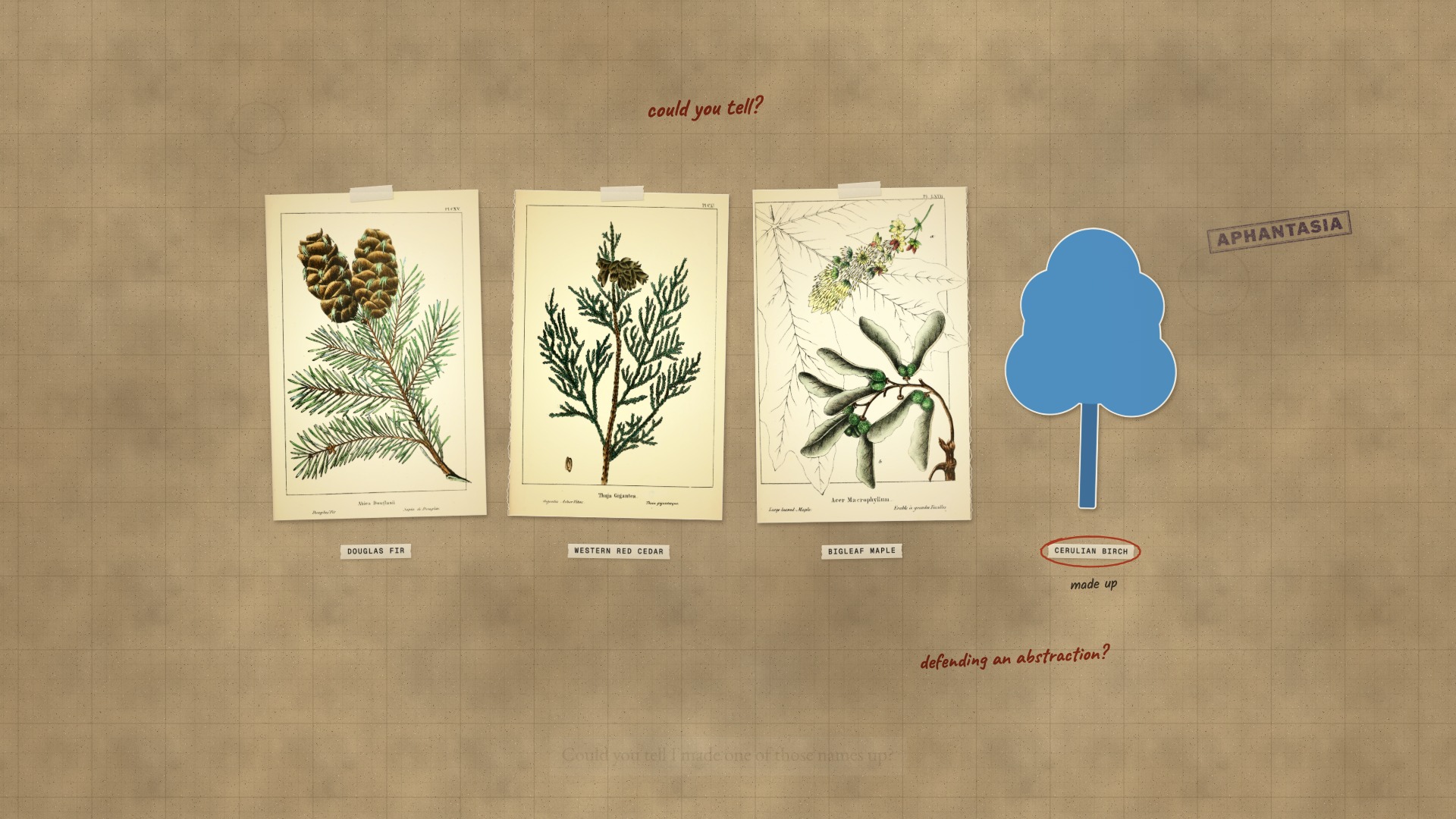
The limits of my language are the limits of my world, and so "Open Sesame" is both magical and linguistic. I remember reading Kimmerer's Braiding Sweetgrass and feeling ashamed at her surprise that people can walk through a forest without knowing the names of the life that surrounds them. This is the curse Powers writes about—Adam's curse of only naming things that look like us. And while my own lack of language here is a sore spot, I also wonder, how many people defending forests online have this same aphantasia? Does Greta Thunberg know the names of trees? As you're reading this, can you actually imagine the Douglas Fir, the Western Red Cedar, the Bigleaf Maple, the Cerulian Birch? Could you tell I made one of those names up? Are environmentalists in some ways defending an abstraction?

Here’s another question, one I find more pressing to my current readings: are you supporting the trees you know, or are you opposing the people you hate? Is your activism embodied—rooted in actual relationship with place and species—or merely conceptual, a performance of virtue against the backdrop of human awfulness? Are you moving towards something you want, or away from something you dislike? The framing and the energy matter, and I left The Overstory feeling more scolded than encouraged.
Welcome to the Misanthropocene
I know that the Anthropocene is a buzzword amongst the climate anxious. Humans have become the dominant geological force shaping the earth's systems, and we're destroying the health of the world at an unsustainable rate. I’m not going to deny that.
In art and culture, though, we've entered what I call the Misanthropocene—where our art and culture focuses on how humans are destroying the world, because we are horrible. Our self awareness has left us jaded mistanthropists, revelling in our self-loathing, and raising the awareness of others through performing our despair. Where the Anthropocene focuses on humans as a geological force and examines our material impact, the Misanthropocene views this as moral failure and encourages performative guilt. The former deploys scientists studying systems; the latter, artists wallowing in shame. Speak truth to power, but don't build any alternatives.
It’s a lot easier to write dystopian fiction than it is to imagine utopian or protopian systems. Dystopias are common tropes now, and they’re becoming formulaic. There's always some authoritarian evil, some hoarding of power, and the protagonist's job isn't to build an alternative society that works, or even to cooperate with opposing views and build something that serves us all, as much as it is to destroy evil. Blow up the Death Star, and throw the ring into the fires of Mordor. We can Make The World Great Again by eliminating the baddies, and left-leaning sentimentalism imagines us foraging berries in fertile lands of abundance, going back to a world before capitalism, in essence, romanticizing a past we will regress to without our current trappings, rather than a future that works with our current technologies and population densities. No billionaires allowed.
Instead of non-judgmentally observing our effects on the world and then choosing actions that align with our higher values and goals, we are describing our effects through shameful language. And, sadly, we're not changing the world for the good. Nuh uh. We're a blight upon it. A cancer. A virus.
And I'm not even sure if we're doing this from a position of loving the environment as much as from one of hating ourselves.
The Fabricated Psychology of Self-Hatred
Two clues led me to thinking of Powers' environmental philosophy as misanthropist. Two of the pillars of the Cynical Canon that I mentioned in my review of Humankind, both of which have crumbled under scrutiny, are unironically referenced in this book as pivotal to the motivations of two of the main characters. Douglas is one of the participants of the Stanford Prison Experiment. While we now know that this "experiment" has been exposed as staged theatre—guards were given scripts, the famous "breakdown" was performed by a student who wanted to leave early to study—in Douglas' reality this experiment wasn't a ruse, and he was deeply affected by it. In another instance, Adam doesn't rush out to save his beloved professor who died in the hallway, for which he cites the Bystander Effect and Kitty Genovese's death. This too was complete fabrication. She died in her friend's arms, who called the police. Multiple people tried to help.
These aren't minor details. They're foundational myths of human cruelty and indifference that justify the Misanthropist’s worldview, and they're both supported in The Overstory. Adam can't sit by and watch the trees die! He has to do something. And so you too, dear reader, shouldn’t be a bystander. Douglas is jaded by the fundamental cruelty of humanity, and so should you, dear reader, as you are acting like the prison guards in torturing and destroying our beloved and innocent trees, just for funsies.
The use of these debunked studies reveals something crucial about Misanthropist thinking—it requires falsified evidence of human awfulness to justify itself. Like a religion that needs original sin, environmental misanthropy needs these psychological "proofs" that we're irredeemable. Without them, we might have to engage with the more complex reality that humans, like forests, contain multitudes, and just like how there are 30,000 shades of green that we can’t recognize, there are many more shades of humanity to discern between black and white.
The Luxury of Despair
I was at the darkest part of my life and profoundly lost when I turned 40. I’m not the first one to feel this way at that age, I know. I took a three year sabbatical, and I spent extensive time wandering in the woods, sitting under trees whose names I didn’t know. I often felt that Nature always asked for more of my time, so that I could sit with it until my death, and then forevermore be part of the trees and the ground that held me.
I haven’t gone to the woods much since getting out of that phase. They always seems a bit too tempting, like how a former alcoholic might feel at a bar. Maybe even a little dangerous. Plants communicate with each other, above and below ground, through roots and smells and sounds. They communicate and coordinate, speak and share. If they're under attack by one species, they release chemicals that attract that species' predators. Trees are animals are humans.
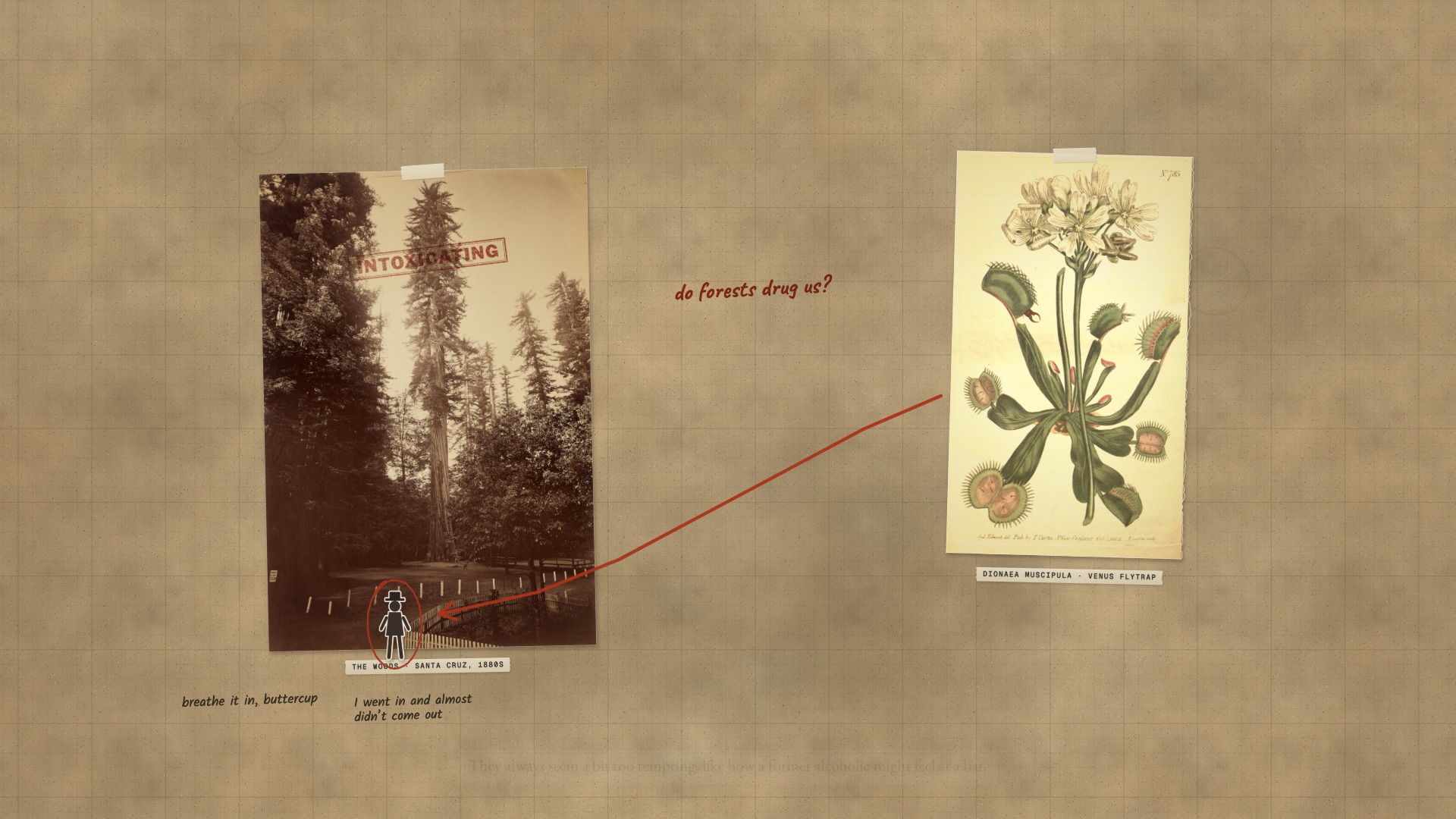
With this in mind, and in knowing how anything sitting still long enough becomes part of the forest—humans, homes, roads—I sometimes wonder if forests drug us. Tree poisons protect them from invaders. Can trees also prey upon others? They can supposedly sense when we’re around them. Do they release any particular chemicals upon sensing us? The forests sure do smell fucking delicious, don't they? What’s in this tree air we’re breathing, after all? Breathe it in, buttercup. That's it. Like the Venus Flytrap, get stuck in it, let it envelop and devour you. It's intoxicating.
Trees are predators and consumers, just as fungus and insects are, just as humans are. We all feed on each other, though we all operate on different time scales, and don’t digest at the same speeds. I can definitely take responsibility for my sense of being lost at 40, and I know that there’s some projection in what I’m saying here, all while acknowledging that I was almost consumed by the forest. I went in and almost didn't come out.
The Misanthropocene refuses to acknowledge that nature isn't an innocent victim of humans predatory ways. Morality doesn’t begin and end with humans, wherever it is they begin and end, and the forest that nearly consumed me wasn't moral or immoral. The bugs that consume the trees aren't either. We're warned against anthropomorphizing trees, except for the parts that hold emotional resonance for us. They speak, listen, and respond, and they nurture each other. They’re conscious. It’s ok to anthropomorphize them when we speak of their innocence, and anything that questions their victim status must be ignored. Our Postmodern, Cynical, Doomer, and Misanthropic bent infantilizes one side of the binary of good and evil. The evil side has agency, while the victims are oppressed by the system and marginalized by the patriarchy.
The Question of Consciousness and Complicity
A couple of months ago Professor Paco Calvo from the University of Murcia gave a guest lecture in my old neighborhood of Graca. For an hour he talked about plant consciousness. When he mentioned that plants can be anesthetized, I was immediately reminded of Hameroff's and Penrose's work connecting consciousness to microtubules. My hand shot up right away during the Q&A session, and we chatted a bit about plant anesthesia and its ramifications on plant consciousness.
The jury is still out. Researchers have disputed some claims from The Hidden Life of Trees, which I only read about when I started writing this review. At the moment, the evidence for plant sentience is far weaker than The Overstory suggests, though researchers like Michael Levin (whose work I love and I did a video talking about him before) offer sophisticated frameworks for understanding plant intelligence without anthropomorphizing and moralizing about it.
Here's the challenge I face when thinking about plant consciousness: if plants are conscious, then ethical consumption becomes impossible. Pig pens are cruel for the same reason that monocropping becomes cruel, and Powers touches on the issues of the planting of new growths as well. The suffering we place on corn might sound absurd now, but if plants are conscious then it we might one day consider our planting practices as unfathomably cruel centuries hence. Animal welfare would have been laughed at 200 years ago.
And if that's the case, then my imagination is starved for thinking of a way for us to survive without subjugating and enslaving. This isn't a uniquely human trait—it's a life trait. Animals eviscerate animal babies. Fungus causes blights on trees. Pain and death are inevitable, and while we can tell ourselves that suffering is optional, and actively work to prevent suffering, the Jainist will see all death we cause as indelible karmic stains.
Beyond the Misanthropocene
Part of what seems to be fuelling Misanthropy is the Postmodern focus on the thermodynamic inefficiency of systems. Every system needs fuel to operate, and every system creates waste. Unless a system is fed more energy from outside of the system itself, the system will eventually collapse. So says the inescapable and brutal second law of thermodynamics. The language of systemic oppression focuses on the harm that systems cause, the fuel they burn and the waste they create. Business systems burn through human resources, as subtler forms of slavery (now rebranded as "wage slavery") becomes more nuanced, intimate, and internalized.
Our systems depend on the intensive exploitation of natural resources to feed other systems: monocropping of plants feeds the animals in factory farms that feed the humans working to feed the businesses that feed the algorithms.
All resources get depleted. If the blight of humanity were removed then some other system would continue to grow until it devours all other systems. The Misanthropic bent doesn't seem to have an answer to this cosmic inevitability. Our sun will continue to expand until, in less than half a billion years, our water boils away. Global warming isn't just a byproduct of humans. Even if we were removed, the sun will continue to get hotter. Eventually all life will become extinct.
What play should we make? I don't think that if humans were removed, trees would find a way to escape their own heat death, so Patricia's ultimate answer in her last section and the logical endpoint of environmentalist "Leave No Trace" principles reveal themselves as the impractical despair of misanthropists. No thanks. The dinosaurs, after all, lived very much in harmony with their environment.
I know many will say that I’ve created a false dichotomy. The two options aren’t accelerate or remove ourselves. Many are hoping for a way to live harmoniously with the planet, and hope that we can slow our rate of growth and build in more renewable systems. At the same time, we're not just concerned about the planet's slow burn but also need to be aware of all the cosmic threats the universe is flinging at our planet. We need answers, and we need them yesterday. We have the best chance right now, with all of the work we're doing, to find a way off this planet and onto others, and to keep life going. Doing this work will cost fuel, work, and energy, and that work doesn't come cheap. While we're at it, we're doing our best ecological transition work, slowly adding alternative and cleaner sources of energy, all while undeveloped parts of the world have the right to raise themselves out of abject poverty.
The Overstory doesn’t offer viable options. We won’t remove ourselves from the picture, nor can we simply sit still.
Stillness is not the Move
Nick had a hilarious timeline. He's a reclusive artist for many years until a manic pixie girl comes to him and appreciates his beauty. She asks him to follow her on her journey guided by magic sprites that came to her after she electrocuted herself at the end of her era of sex and drugs. Nick's raging erection becomes his compass as he follows her up a giant tree where they have sex for a year. Her plan doesn't work out, they leave the tree, and then she comes up with another plan, which also doesn't work out, and so then they resort to arson, which also doesn’t work, and she dies by accident, and then he roams the woods and makes more art. His last piece is a big sign that says STILL. That's it. Just a very big STILL.
The literary nerd in me recognizes the allusion to David Wagoner's poem Lost at the end of the book when Nick is lost in the woods, and he thinks that the trees aren't lost, and that the birds all know the names of the trees. The advice Lost offers seems to be the inspiration for Nick's final piece.
Stand still. The trees ahead and bushes beside you Are not lost. Wherever you are is called Here, And you must treat it as a powerful stranger, Must ask permission to know it and be known. The forest breathes. Listen. It answers, I have made this place around you. If you leave it, you may come back again, saying Here. No two trees are the same to Raven. No two branches are the same to Wren. If what a tree or a bush does is lost on you, You are surely lost. Stand still. The forest knows Where you are. You must let it find you.
The Postmodern and Misanthropic threads weave together in Nick’s final art work, in his attempt to capture life in some form that will outlive the artist. Shakespeare's works live on beyond his dusty death. The hope to make something that stands still, that doesn't change, that doesn't participate in a system of oppression, is naive and egocentric. Trees stand still and await their fiery deaths.
Those of us with health and vitality still in us, those of us that don't want to die, that want to keep humanity alive and the light of consciousness still flickering, won't stand still. We'll move, keep trying, keep burning the fires within us, and find some way off our doomed planet. Misanthropic artists would rather let the world burn, just not in their lifetimes, but in some future after their deaths.
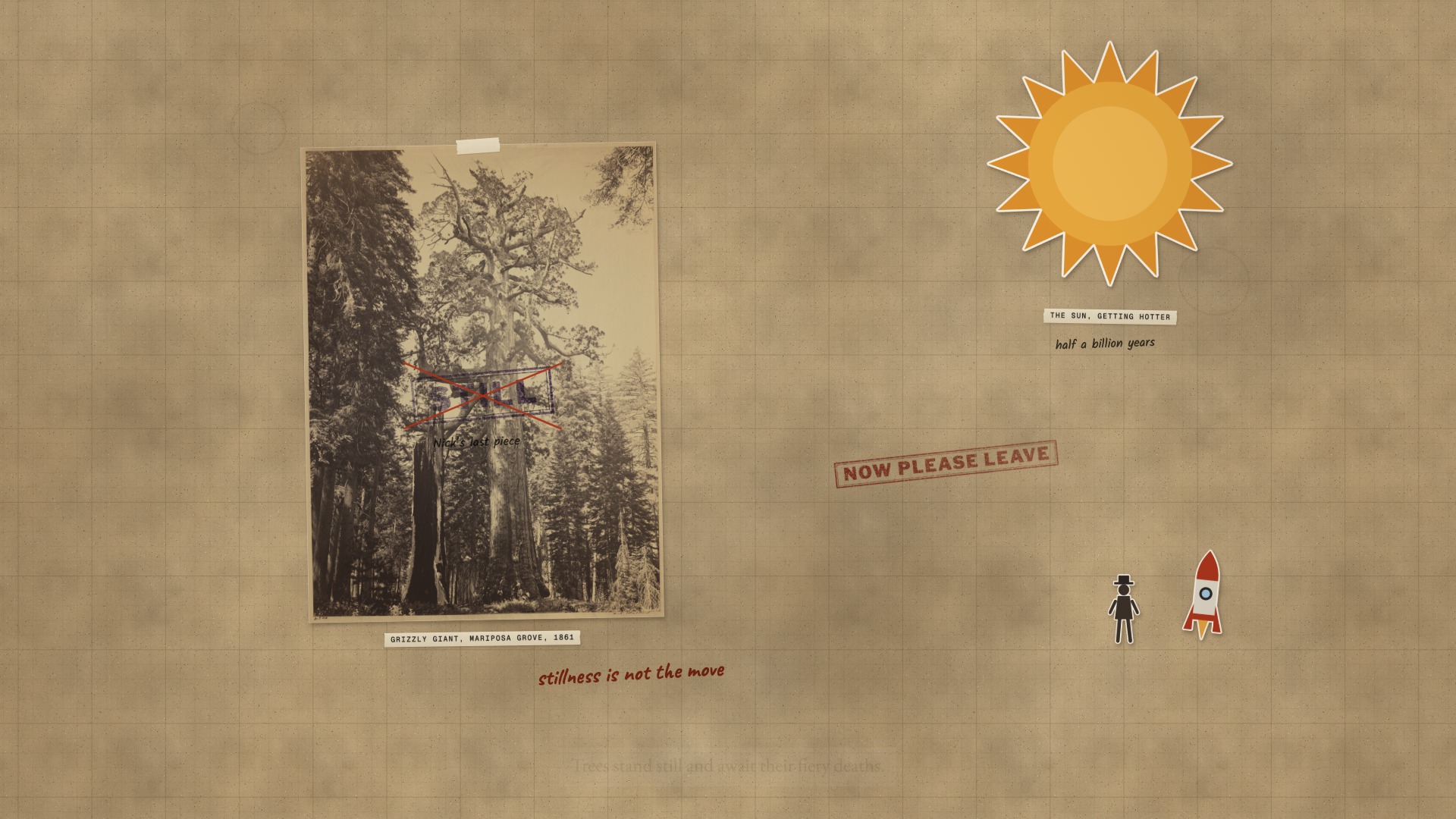
Powers has written the Misanthropocene's masterpiece, complete with fabricated psychology, performative despair, and the paradox of using trees to tell us how awful we are for using trees. It's a book that mistakes self-hatred for environmental love, that confuses the performance of virtue with its practice.
I'm very happy to finally have this book out of my system. I'll never read it again, and I won't recommend it to anyone I know. Thanks for reading this long essay. I just finished reading Lincoln in the Bardo and it was the best thing I've read all year. I'll publish that review next. See you soon!
Read the newsletter edition on Substack · Subscribe
Credits
- “Twin Redwoods, Palo Alto”, by Carleton E. Watkins, 1870, National Gallery of Art · CC0 1.0 · Source
- “Washington forest, about 1925”, by Asahel Curtis, Seattle Public Library, via the Digital Public Library of America · Public domain · Source
- “Abies Douglasii, Douglas Fir, plate CXV of The North American Sylva”, by Thomas Nuttall and François André Michaux, 1865 edition, Internet Archive Book Images · Public domain · Source
- “Thuja Gigantea, Gigantic Arbor Vitae, plate CXI of The North American Sylva”, by Thomas Nuttall and François André Michaux, 1865 edition, Internet Archive Book Images · Public domain · Source
- “Acer Macrophyllum, Large-leaved Maple, plate LXVII of The North American Sylva”, by Thomas Nuttall and François André Michaux, 1865 edition, Biodiversity Heritage Library · Public domain · Source
- “Dionaea muscipula, Curtis’s Botanical Magazine No. 785”, by William Curtis, 1804, Biodiversity Heritage Library · Public domain · Source
- “Giant Redwood, Santa Cruz”, by Carleton Watkins, 1880s, via Google Art Project · Public domain · Source
- “Grizzly Giant, Mariposa Grove”, by Carleton E. Watkins, 1861, National Gallery of Art · CC0 1.0 · Source


